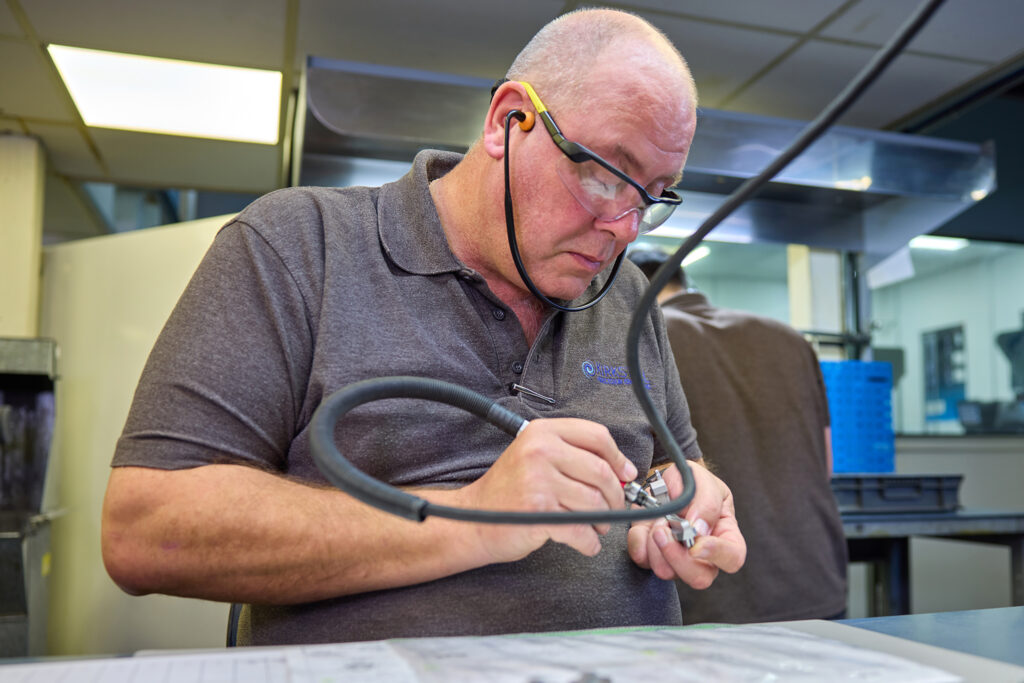
Walk into Kirkstall’s finishing department on any work day and you’ll probably find Chris Remmer doing what he’s done here for more than two decades, making parts “look pretty” and then turning them into something far more important.
“I’m a fitter, finisher, welder,” he says. “We get parts from the machine shops, deburr them, make them look right and put them together to produce the finished instrument.”
It sounds simple when he says it. It isn’t.
From “scratching the surface” to specialist med-tech
Chris joined Kirkstall back in 2002, when the business was still a more general engineering firm.
“It was a smaller team, a smaller building,” he recalls. “We were just scratching the surface of the medical side. There were a couple of medical customers coming through, but plenty of other work, card cutting machinery, parts for the oil industry and even work for a few Formula One teams.”
As more medical work arrived, everything had to step up, tolerances, documentation, cleanliness, traceability. Orthopaedic and spinal instruments don’t just need to work; they need to be safe in theatre, survive repeated sterilisation cycles and meet tight regulatory standards. Surface finish alone can affect wear, corrosion resistance and long-term performance of implants and instruments.
https://www.sciencedirect.com/science/article/abs/pii/S0007850608000693?utm_source=chatgpt.com
Chris saw that shift first hand.
“Getting in with more medical companies meant learning a lot more about the medical side of things,” he says. “It’s so much more stringent. There are so many more things to watch for.”
When Adam Thornton took over from his father John, the focus sharpened again.
“The mindset became: we want to be a medical supplier,” Chris explains. “Phase out as much of the old general engineering as we can and concentrate solely on medical. And that’s where we are today, now with Kaleidex involved and even more people on board.”
The last hands on the part
By the time a part reaches finishing, plenty of expertise has already gone into it: design, process engineering, CNC programming and machining. But finishing is usually the last set of hands on an instrument before it becomes something a surgeon can trust.
That means deburring sharp edges that shouldn’t be sharp. It means blending surfaces so joints move smoothly. It means checking every thread, every radius, every strike plate.
The work ranges from “something as simple as a single-piece drill” to complex assemblies “used for actually impacting hip implants into the body,” Chris says. Some tools have locking mechanisms; others have hardened strike plates designed to take repeated blows from a mallet in surgery.
On paper, that might read like a series of steps. In reality, it’s judgement, built up over years.
There’s no college module titled “how to dress a strike plate so it takes a lifetime of hammer blows” or “how to feel when a sliding mechanism is smooth enough for a surgeon under pressure”. Those skills live in people like Chris.
“You don’t always learn this stuff in colleges and universities,” he says. “You only really pick it up from people who’ve been in the industry a long time.”
Passing the craft on
That’s why he spends so much time with Kirkstall’s apprentices and newer recruits.
Sometimes they arrive with good theoretical grounding and textbook knowledge. Sometimes they arrive as a “blank canvas”.
“Which is a great place to start,” Chris smiles. “Sometimes there’s nothing there, it’s just the information you’re giving them. When you get an apprentice who’s interested and asks, ‘Why did you do that?’ or ‘Why do you use this?’, that’s when it’s really good.”
For him, teaching is as much about mindset as it is about method. He wants them to see the real-world impact behind the parts they handle every day.
“You see some of the things we make and at first you’ve no clue what they do,” he says. “You ask questions, do a bit of research, and then you realise: that could be really useful. You can clearly see how it might improve someone’s quality of life after surgery. It does make you feel good to know you’re contributing to something like that.”
That sense of purpose helps on the tougher days too, when the job is fiddly, the deadline tight, or the tolerance unforgiving.
Everyday work, extraordinary outcomes
Not every day in finishing is a brand new challenge. Some jobs Chris has done “a hundred times before”, instruments that have become staples of the operating theatre. But even the familiar work matters.
“Everybody likes that repetition sometimes,” he admits. “You know what you’re doing, you can get into a rhythm.”
Then there are the other days.
“You can get something that’s almost out of left field,” he says. “We’re getting work from companies at the forefront of this industry, using the latest technology. Some of the ideas are phenomenal. You do find yourself wondering, ‘Where did they come up with this?’”
From his bench in finishing, he sees a cross-section of med-tech innovation: dynamic fixation systems, complex spinal constructs, clever instruments that reduce surgical steps or make a procedure less invasive. His job is to make sure the metalwork lives up to the design.
Why people like Chris matter to med-tech
In an industry obsessed, rightly, with digital detail, CAD models and validated processes, it’s easy to forget how much still depends on human skill.
Surface-finish standards and inspection tools can tell you whether a part meets spec. They can’t always tell you whether a mechanism feels right in the hand, or whether a surgeon will trust it when the theatre is busy and the pressure is on.
That’s where experience comes in. Years of filing, polishing, assembling and testing give people like Chris a built-in reference library. They know what “good” feels like.
And because they’re involved in so many different products, from single drills to multi-component impactors, they see patterns others might miss: where designs are clever, where they’re awkward to assemble, where a small tweak could make cleaning or finishing easier.
The next 20 years
Chris is modest about his contribution. Ask him what keeps him at Kirkstall after 23 years and he shrugs.
“There’s always something different coming through the door,” he says. “You don’t always know what you’re going to get, and some of it is really interesting work.”
But behind that understatement is the reality: med-tech needs people who stay long enough to see an industry change around them and still want to pass on what they’ve learned.