When you speak to Sarah Wood, her job title sounds deceptively simple: Operational Excellence Manager. But within a few minutes you realise she’s not just here to tweak processes, she’s here to rewire how a growing med-tech manufacturer thinks, works, collaborates, and improves.
“It does exactly what it says on the tin,” she laughs. “My aim is to make the operations here… excellent.”
Straightforward. But not small. Because “excellent” in a medical manufacturing environment isn’t a mood, it’s a discipline. It’s thousands of small decisions, countless tiny efficiencies, and a mindset that never stops asking: Could this be better.
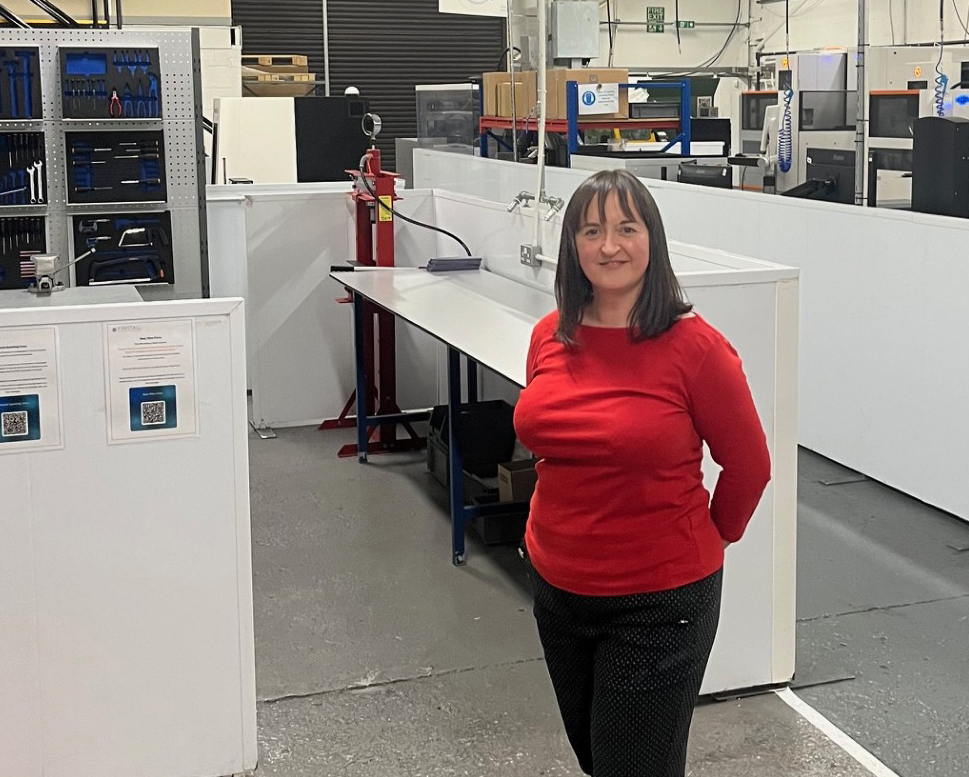
From global corporates to a close-knit med-tech tea
Before joining Kirkstall Precision, Sarah spent her career inside very large corporate organisations, sprawling global structures with layers of management, miles of email chains, and change programmes that could take years to unfold.
Kirkstall, by comparison, was a different planet.
“I’d never worked in an SME before,” she explains. “I didn’t really know what to expect. But I was attracted to the journey, the momentum behind Kirkstall, the formation of the Kaleidex Group, the mergers, the acquisitions. From an operational excellence perspective, that’s a playground of opportunity.”
It wasn’t the size of the company that hooked her. It was the blank page.
“Some people don’t like blank pages,” she says. “They want something already defined. But I’m the opposite, I love the creative part of starting fresh. I like building, shaping, collaborating. That’s what Kaleidex and Kirkstall offered: the chance to create something the right way from the ground up.”
And when she arrived?
“I was welcomed with open arms,” she smiles. “Massively. Hugely. That immediate warmth makes such a difference.”
At a global conglomerate, she might interact with a fraction of the people she supports. Here, she speaks to everyone, every day.
“It’s so much easier to make meaningful change when you can just walk over, have a conversation, clear a concern, get an idea. It makes the work exciting.”
Why small changes matter more than big ones
A lot of people hear “Operational Excellence” and picture whiteboards full of diagrams, huge workshops, or months-long programmes. That’s not Sarah’s philosophy.
Her favourite tool? Kaizen, the practice of continuous improvement through small change.
In Japanese, kaizen literally means small change. And that’s the part people often forget.
“You don’t need expensive new systems or months of planning to make meaningful impact,” she says. “Small adjustments if you stack enough of them, can transform an operation.”
Like the vending machine.
Not glamorous. Not strategic. But incredibly effective.
Kirkstall’s CNC tooling vending system was functional, but the flow around it wasn’t. Operators walked further than they needed to. The technical admin team walked back and forth repeatedly to refill stock. The third-party vendor had to take the scenic route around the building to load the machine.
So Sarah moved one cupboard.
That’s it. One cupboard.
And suddenly:
- The technical admin team cut out dozens of unnecessary trips.
- The tool vendor halved their walking distance.
- CNC operators could grab what they needed faster.
- Flow improved, waste dropped, frustrations evaporated.
“All from moving one cupboard and giving an extra person a key,” she laughs. “That’s the beauty of kaizen, tiny change, big impact.”
It’s the same thinking she applies in everyday life.
She jokes about her kitchen being designed like a lean manufacturing cell: kettle next to cups, cups next to fridge, tea next to coffee, everything positioned to minimise waste and unnecessary movement.
“I just don’t see the point in running a marathon to make a cup of tea,” she grins.
A natural instinct, shaped by years of experience
When asked where her passion for improvement comes from, Sarah doesn’t hesitate.
“It’s just part of my nature,” she says. “I like things to be efficient. If I’m going upstairs to put makeup on, I’ll take some of my son’s toys with me so I’m solving two problems at once.”
But instinct alone isn’t enough. Her background working across mature, complex organisations means she’s seen every flavour of process, the good, the bad, and the bureaucratic.
Here, that experience actually accelerates change.
“This is the most receptive workforce I’ve ever worked with,” she says. “People here want to try things. They want improvement. That willingness is extraordinary.”
In big companies, ideas often disappear into the void. Here, ideas turn into action the same week.
That’s why she believes she’ll make her biggest career impact at Kirkstall.
“In my entire career, this is probably where I’ll make the most difference,” she says. “Because the environment allows it.”
Building excellence inside a med-tech ecosystem
One of the unexpected motivations for Sarah has been seeing the clinical reality behind the work.
Kirkstall’s customers create orthopaedic and spinal systems that change patients’ lives. To help the team understand that impact, some customers recently visited Kirkstall’s Town Hall meeting, showing the instruments in action, explaining tolerances, demonstrating why certain features were critical to surgical success.
For Sarah, this connection has been transformative.
“It gives you an extra motivation,” she says. “You understand exactly why we need precision, why we need consistency, why certain processes matter. It’s not just metal. It’s someone’s operation. Someone’s recovery.”
That significance fuels her team’s commitment to excellence — because the stakes aren’t operational, they’re human.
Kaleidex, growth and the thrill of building something new
The formation of the Kaleidex Group has only amplified the excitement. As the group grows, new acquisitions, new synergies, shared capabilities, the opportunity for operational alignment grows with it.
“To me, that’s incredibly exciting,” she says. “We’re building structures, standards and systems that multiple companies will benefit from. Everything is evolving at once, the group, the businesses within it, and the operational frameworks that hold it together.”
It’s not just improvement. It’s creation. A collaborative, people-centred, purpose-driven blueprint for excellence across a modern med-tech organisation.
“That blank piece of paper still motivates me,” she says. “We’re shaping something that works properly, right from the start.”
More than metal, more than process, a purpose
Operational excellence can sound mechanical. But for Sarah, it’s deeply human.
She knows that every improvement she helps implement, every minute saved, every frustration removed, every process clarified, ripples outward into the quality of tools that surgeons will use on real patients.
“If what we’re doing helps someone have a great operation, an easier healing process, a better quality of life… then it’s about far more than efficiency.”
It’s not just cutting bits of metal.
“It’s meaningful,” she says simply.