

On the Kirkstall shop floor, what a good day ‘looks like’, feels clear, calm and productive. Tools are where they should be, machines are clean, setups run first time and interruptions are rare. That feeling is being engineered on purpose through 5S, a lean, Japanese-born approach built on five simple habits: Sort, Set in Order, Shine, Standardise, Sustain.
“5S is the foundation of operational excellence,” says Sarah Wood, Kirkstall’s Operational Excellence (OPEX) Manager. “When there’s a place for everything, and everything returns to its place, you remove friction from people’s day. You don’t waste minutes hunting a tool or discovering it’s damaged. You reduce delays and defects. And the work feels better. That matters.”
The power of early adopters
The programme has momentum thanks to early adopters like Carl Wilkinson, CNC operator on the STAR sliding-head machines and the first appointed 5S Champion. His opening target sounded simple: collets. Over time, boxes had become a jumble, mixed sizes, oily residue, odd parts going walkabout. Wilkinson tackled it head-on.
“I cleaned the boxes, re-identified the sizes, sorted and separated the sets,” he explains. “Three S’s in one go: sort, set in order, shine. The benefit is immediate, you get the right collet first time, your hands don’t come back covered in oil, you hit your setup time and get the machine cutting.”
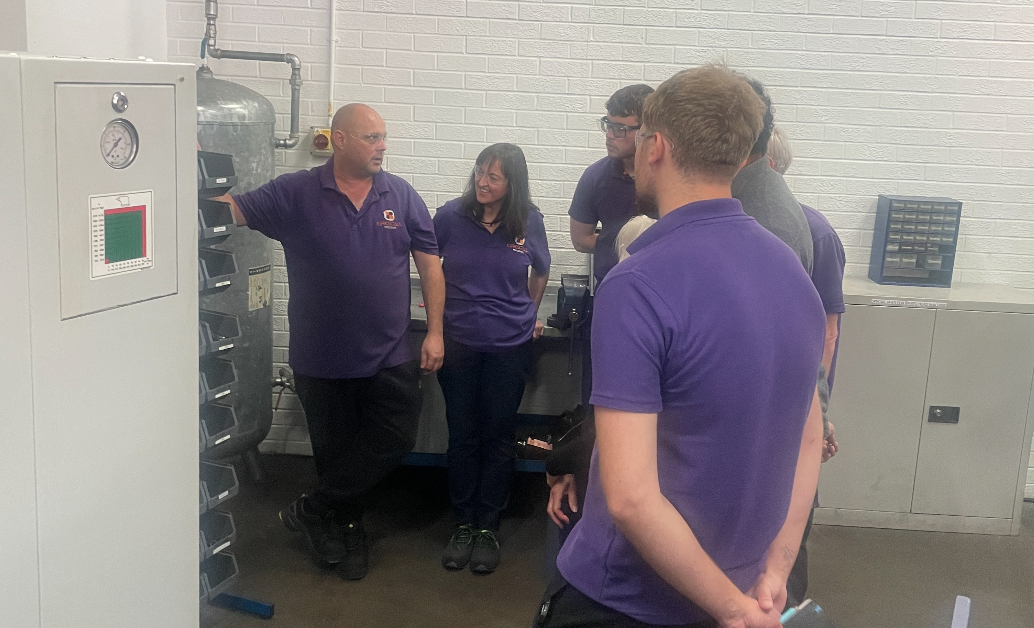
That quick win turned into a teaching moment. Wilkinson walked champions from Milling, Grinding and Assembly through what he’d done so they could lift-and-shift the approach. “Peer-to-peer coaching accelerates everything,” Wood notes. “We deliberately start by completing the first three S’s everywhere, prove the value this week, not next quarter, then move into the harder steps: standardise and sustain.”
Those last two S’s are where many programmes stall. Locking in the gains takes thought, discipline and, sometimes, a little budget. “Standardisation is agreeing the best way, together,” Wood says. “It might be shadow-foamed drawers once we’re sure the layout’s right, common naming on programs so anyone can understand a setup, and visual controls on racks and trolleys. It’s not glamorous, but it’s powerful.”
Sustain to keep standards alive
Sustain is about systems that keep standards alive when things get busy. “Quick daily checks, simple audits, and visual cues that trigger action without meetings or emails,” Wood adds. She’s working with the Milling team on a supermarket-style pull system: when the last tool leaves a bin, a red card appears; twice a week the technical administrator walks the area, collects red cards and places replenishment orders. “No guesswork, no stock-outs, no ‘I thought someone else was doing that,’” she says.
Housekeeping is getting the same treatment. Wilkinson is designing cleaning stations so brooms, mops and fluids are always to hand, mounted, labelled and hard to misplace. “If you know where everything is, you get it, use it, and move on,” he says. “It’s nicer to work in a clean space, and in medical device manufacturing it underpins everything, quality, safety, compliance.”
The cultural effects show up quickly. When tools have a home and standards are clear, the atmosphere changes. “People relax,” Wood observes. “Setups run smoother. Colleagues help each other keep areas tidy because the benefit is obvious. I talk about ‘flow’, that sports-team feeling where the ball moves effortlessly up the pitch because everyone knows their role. In a theatre, surgeons, scrub nurses and anaesthetists move as one. In a great factory, it’s the same pattern. 5S builds the environment where that can happen.”
When the benefits are clear, people adopt
Scepticism fades with results. “Bringing new things into a company can be hard at first because you’re asking people to change habits,” Wilkinson says. “So I’ll often take the initiative, do a small area myself, and show the benefits. Once the lads see it saves time and frustration, they take it on.”
Momentum is spreading. After Wilkinson’s demo, more champions stepped up, including Milling’s Cameron Dowling, who re-5S’d a tooling room that had slipped. “Many sites have done 5S in the past,” Wood says. “If the sustain piece isn’t in place, standards drift. Now our champions are asking the right questions: ‘Why did it slip? What standard and system will keep it where we want it?’”
There’s a commercial edge to all of this, and the commitment to Operational Excellence comes from the top. Kirkstall is supported by its leaders. A strong advocate of Lean Excellence, and a practitioner himself, Giles Hodgson remarks “There is a lot of focus on Productivity within British industry currently. 5S is one of the foundational pieces on which high productivity is built. I’m therefore fully behind the implementation of 5S throughout Kirkstall Precision.”
Faster changeovers and fewer stoppages mean more capacity on the same assets. Clean, consistent workspaces reduce errors that cost time and reputation. “For a company supplying components for medical and veterinary devices where quality without compromise is non-negotiable, those gains matter,” in partnership with Hodgson, Wood emphasises. “But the deeper value is pride in giving people a frustration-free day.”
That pride is personal. “If I go home and don’t feel productive, I don’t feel like I’ve done my job,” Wilkinson admits. “What I hope is that by showing what 5S can do, others pick it up, maintain it and make their day easier too.”
Searching for the wider benefits
Wood’s horizon is longer but just as human. “Yes, I want the obvious benefits, higher productivity, increased revenues, more profit for shareholders,” she says. “But I’m really chasing the hidden ones: people feeling relaxed at work, the sense of flow, the joy of a team that’s in sync. When you reach a high level of operational excellence, problems are handled seamlessly, everyone knows where everything is, and you leave work feeling you achieved what you came for.”
The roadmap is simple: complete 3S everywhere, agree to the standards that make sense for each area, then install the light-touch systems that keep it that way. Quarterly huddles of champions will share best practice. Visual management will tighten. Reorder loops will remove excuses. And cleaning stations will make “sweep the sheds” a daily habit.
Strip away the Japanese terms and 5S is easy to recognise. It’s labels and lines on the floor, foam cut-outs and tidy trolleys, bins that never run empty and tool drawers that make sense to everyone. It’s also a promise voiced in different ways by both leaders. “We care enough about each other’s day to make the right way the easy way,” says Wood. “Once people get over the first hurdle, they move forward fast,” adds Wilkinson.
At Kirkstall, that’s how everyday excellence is being built, one drawer, one machine, one shared standard at a time.